

How To Repair Top Of A Post That's Rotting
How to Repair a Load-Begetting Post
Floor sagging? Here's the solid cure for rotting posts and sinking footings.
 Time
Time
Multiple Days
 Complexity
Intermediate
 Price
Price
$101–250
Introduction
Acquire to identify the most common causes of floor sagging and what to do about it. We'll prove you the all-time tools and methods for lifting and shoring a load-bearing beam and the steps to safely replace a rotted post.
Tools Required
Materials Required
- ½" dia. rebar
- ii x 10 weight-spreader boards
- 4000 PSI concrete (minimum)
- Ballast commodities
- Concrete plinth cake
- Heavy duty galvanized metal straps
- Heavy duty T-caryatid
- Joist hanger nails
- Sill sealer
- Woods post (4 x 4 or 6 x six) for jacking
Sagging floors, doors that won't close and cracks that announced in interior walls can be symptomatic of a more than serious problem. Y'all may accept undersized support beams, support posts that are rotting and losing their structural integrity, or undersized postal service footings that are settling. Information technology'due south important to stop this trouble and reverse it before it gets worse and becomes more costly to repair.
We'll show you lot how to identify two common causes of floor sagging, the best tools for lifting and shoring (temporarily supporting) a house axle, and the steps to safely supersede a post. The actual work of repairing iii to four posts and footings takes 3 or four working days spread over 10 days. Add to that the time to plan the piece of work and obtain any required building permits.
Plus: Have you thought nearly removing a load-begetting wall in your dwelling? Here's what you need to know.
Raising the main axle that carries the floors and interior walls of a business firm is circuitous. Don't tackle it if you're a novice. When you raise a business firm even ane/2 in., the furnishings tin can ripple through the building's framing, plaster walls, rigid pipe and chimneys. For this reason, but specialty contractors should heighten a beam or wall more than about 1 in. or undertake extensive flooring leveling.
Project step-past-footstep (fifteen)
Step 1
Identify the Problem
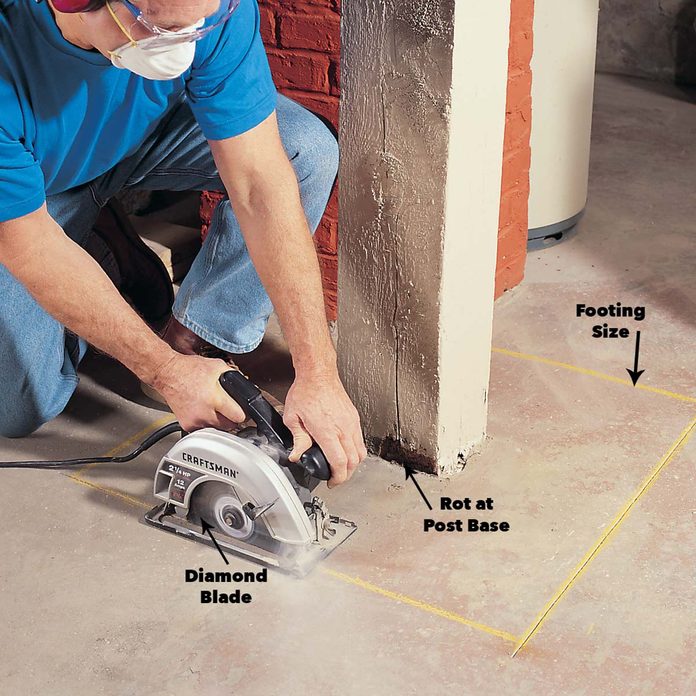
Floors sag because the load bearing posts supporting a house beam are declining and/or the footings belongings those posts are undersized and sinking. Diagnose the trouble by seeking the easiest solution kickoff; get further only every bit needed. If your posts directly contact the floor, start by using a screwdriver to probe the base of your wood posts to reveal whatsoever rot that could have caused them to settle.
If the post isn't rotting, the concrete footing it's on is almost certainly sinking or has deteriorated. Compare the one-time footing'due south dimensions with an engineer's recommendations and current code requirements. To get at the ground, yous'll accept to saw through and strip off the concrete floor covering information technology, then dig down one side of the footing until you can measure its length, width and thickness. The 7-1/4 in. round saw we used won't cut through slabs more than two-i/2 in. thick. For cut through thicker slabs, rent a xiv-in. concrete saw fitted with a diamond bract. Hang plastic sheeting to block migrating dust.
To begin cutting out the old floor, mark the size of the new footing and cutting the outline with a round saw fitted with a diamond masonry blade. Start by making a one-in. deep plunge cut on each side of the mail. Brand successively deeper 1-in. cuts until soil pulled from underneath the slab tells you the concrete has been breached.
Our floor sagging occurred because the post bottoms had rotted and the footings were undersized. Besides pouring new footings and restoring the posts, nosotros added plinth blocks to elevate the wood in a higher place moisture on the basement floor.
Pace 2
Go Adept Advice

Posts and footings support the weight of your house, so y'all accept to size them correct. Load-bearing posts must have a solid ground on undisturbed soil, and all parts of the post must exist attached together. Consult with a structural engineer, local building officials and contractors who specialize in this piece of work. Rent the professionals to review all aspects of your project and provide the calculations and drawings necessary to obtain a building let (Fig. A, shown higher up). Interview those who do residential work and have feel with this type of project. Yous tin expect them to:
-
- Evaluate soil and its load-bearing capacity.
- Examine your house to identify possible problems from jacking it.
- Summate proper basis, beam and load bearing post sizes.
Review your work plan. Show them the ceiling jack, shoring posts and spreader boards you intend to use to make sure they're sized to lift and safely hold your firm beam.

Step 3
Split Pipes From the Beam and Gear up for Lifting and Shoring
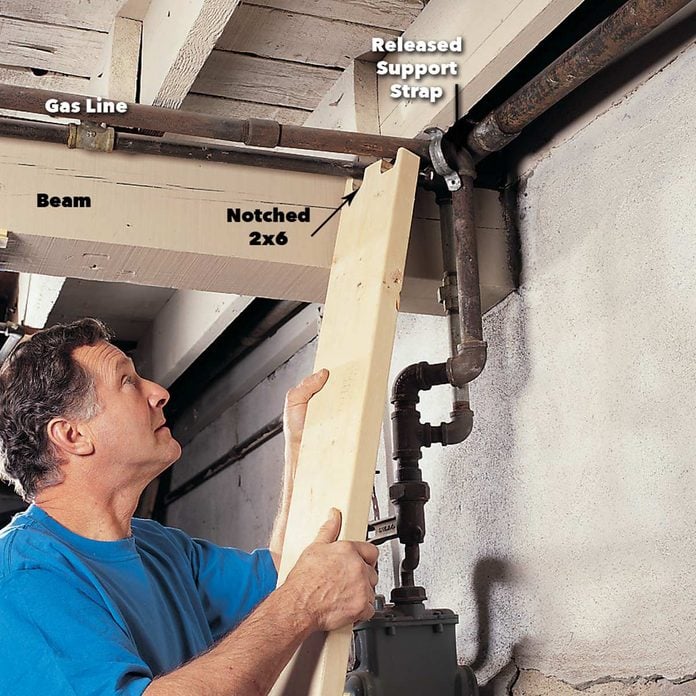
Release all rigid connections between gas, heating, plumbing or electrical lines (in conduit) and the house axle. To avoid rupturing these lines while the axle is being raised, back up them with a 2x6.
Repair or replace posts or footings by raising the beam with a hydraulic jack and 4x4 post, then shoring it with adaptable steel posts. Buy a hydraulic jack and rent the shoring posts for the project. If you lot're removing and resetting more than i basement post, utilize ane hydraulic jack and move from station to station as you install and subsequently remove the shoring posts.
As a house beam is raised, whatever rigid plumbing, gas, electrical or heating lines in the basement connected to the beam, the floors or walls above could rupture. Before jacking the axle, release the connectors holding these lines and support them with lumber resting on the basement floor. To monitor the total rise during lifting, measure out and write the floor-to-beam heights on the axle where hydraulic jacks will be placed. So remove or cutting any nails, screws or straps that join the load begetting posts to the beam.
Pace 4
Place the Hydraulic Jack

To avoid cracking the basement flooring, lay 2 "weight-spreader" boards under hydraulic jacks and shoring posts. The boards should exist two iii-ft. long 2x10 boards a minimum of 6 in. from the sides of the pigsty. Place the boards flat and level to ensure a safe lifting base for the jacks and posts. Then centre a hydraulic ceiling jack direct nether the beam's lifting bespeak using a plumb bob. Make sure the jack is perfectly plumb and sits solidly level on the boards. If you have a concrete floor less than ii in. thick, ask the engineer if y'all should substitute thicker lumber to prevent floor cracking. Check along the cut edge of the concrete floor for voids that would collapse under lifting pressure. If you lot observe any, enquire the engineer for remedies to the problem.
Jacks apply tons of hydraulic force to lift the wood jacking mail service and axle, so select a about knot-costless Douglas fir or Southern yellow pino 4×4. Don't utilize 2x4s or weaker woods like cedar or redwood. Utilise a 6×6 if you're jacking houses with ii or more stories.
Step 5
Set the Jacking Post

Once the spreader boards are laid and the hydraulic jack is set in place, cut the 4×iv or 6x6 jacking post to fit between the jack piston and the beam. Measure the height between the back up beam and the height of the jack's lowered piston, then deduct ane/2 in. and cut the post to length. Place a 1/4-in. thick steel plate between the piston and the bottom of the load begetting mail to prevent the piston from becoming embedded in the post. Snug the mail up to the beam past closing the jack'south release valve and pumping the jack handle upwards and down to raise the piston.
Pace 6
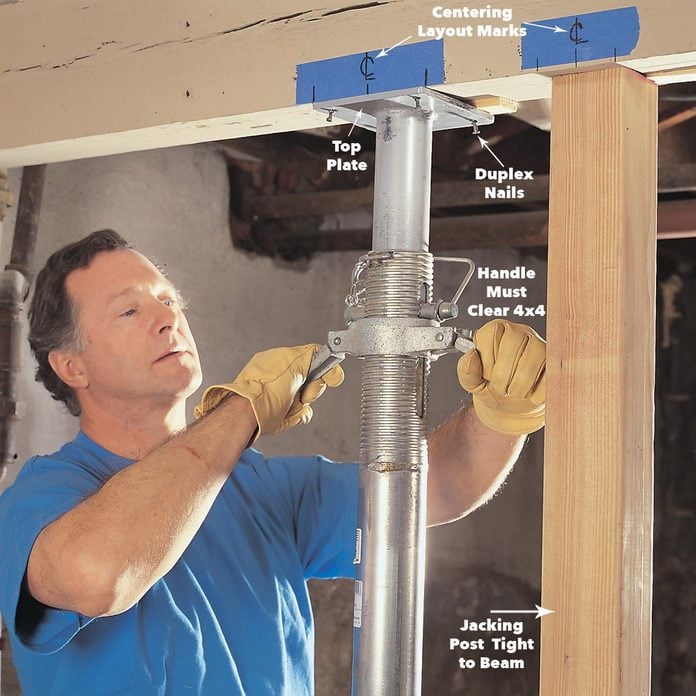
Centre a shoring post on its spreader boards about 12 in. from the 4x4 jacking postal service. Then lower the mail service'southward screw head to its lowest position, enhance the telescoping sections as high equally they'll become under the beam and insert the metal pins to lock the sections together. Heighten the spiral head to its centered position under the beam and attach the top plate to the beam with duplex nails. Now you're prepare to lift.
Step 7
Safely Lift the Axle
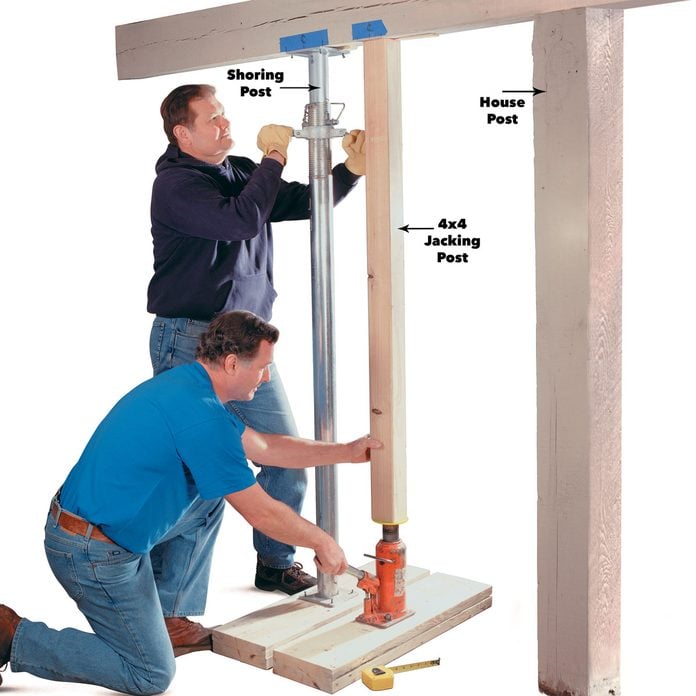
Raise the house beam past pumping the hydraulic jack very slowly using brusk strokes. Raise information technology no more 1/2 to 1 in. total to release the weight from each mail. Measure out from the flooring to the beam to monitor the beam's rise. Have an assistant simultaneously raise the shoring mail service as tight every bit possible against the axle to provide backup load support. When the quondam post loosens, remove and label it for reuse.
I take never lifted a house beam without having the hairs stand up upwardly on my neck as I pumped the jack and heard the axle, floors and walls in a higher place groaning in response. Before lifting, double-cheque your equipment, visualize your program and remember safe. Follow these rules:
- But employ shoring posts rated to bear your beam load. Rent whatever blazon exceeds the load specified past the structural engineer.
- As the hydraulic jack lifts the beam, turn the handle of the shoring post to go on the post head tight to the axle.
- Only use shoring posts to support a beam while work is underway. Never apply hydraulic jacks every bit shoring devices. Jacks may have defective internal seals that could leak hydraulic fluid and cause the jack to slip and drib the load.
- Raise the beam only until the post is released. In one case the load is released from the sometime mail, have an assistant remove the post. And so characterization both its top end and its location along the beam for exact repositioning afterward.
Step 8
Dig the Footing

If y'all have to replace undersized footings, information technology's fourth dimension to excavate, place steel reinforcing rods and cascade concrete for them. With the mail removed, interruption out an undersized footing with a sledgehammer and shovel (wear goggles and gloves) and pour the new one.
Excavate the footing hole to the specified size, excavation the sides and bottom of the hole square and level. Scrape loose soil from the bottom of the pigsty until you accomplish the undisturbed soil. If the soil caves in along the edges, install 1/2-in. plywood to hold the clay back. Remove them while pouring the concrete. Every bit shown higher up, during excavation, make a depth gauge to ensure a footing with uniform thickness and a level bottom.
Footstep 9
Place the Rebar
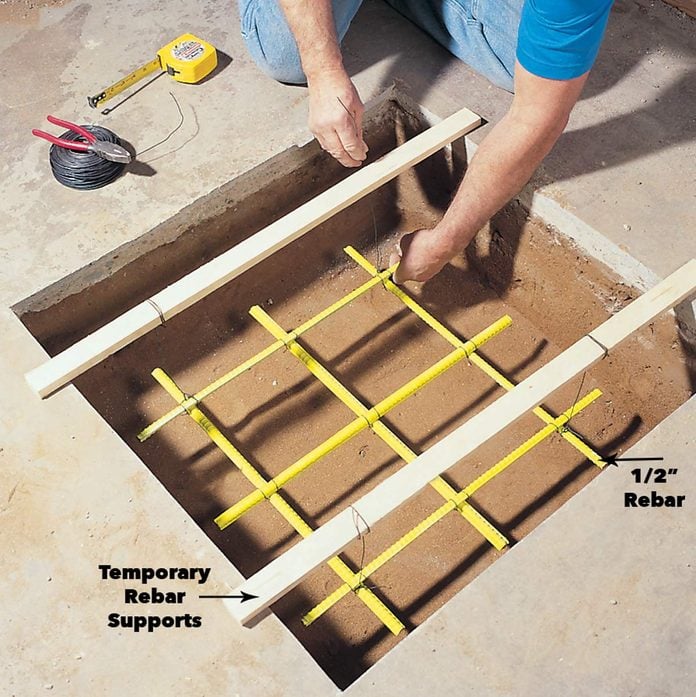
Install rust-complimentary, 1/2-in. dia. reinforcing rod (rebar) to strengthen the concrete ground. Purchase 2-ft. lengths of 1/ii-in. rebar at home centers. Adjacent, suspend the rebar in the lower third of the basis and necktie the rebar together using 16-approximate wire.
Step x
Pour the Footing
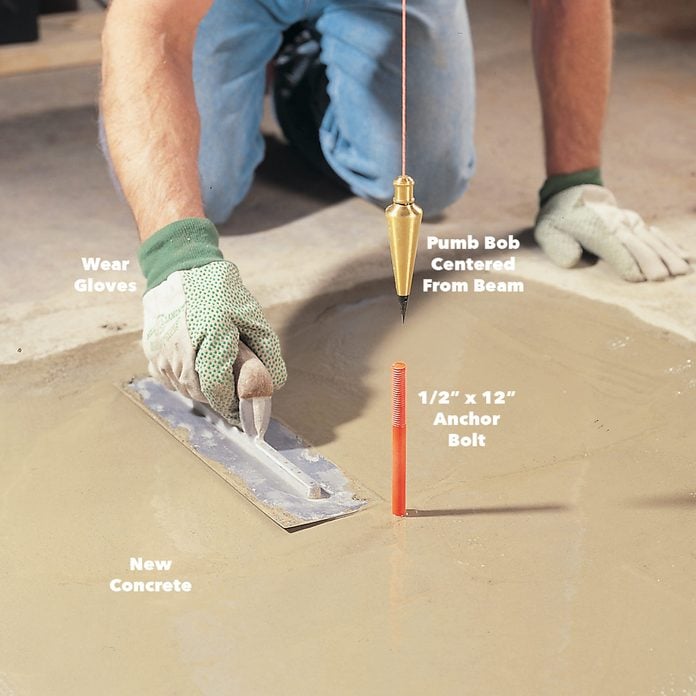
Pour concrete into the hole to the level of the existing flooring and smooth information technology with a steel trowel. Select concrete with a minimum compressive force of 4,000 psi (check the packaging, or order information technology that way). For maximum force, add only the amount of water specified by the manufacturer. Also, be certain to mix and pour all the concrete for each footing in less than one hour then that the batches bond well. Finally, suspend a plumb bob from the mail service'due south center indicate under the beam above and place a 1/ii-in. x 12-in. ballast commodities in the wet mud. Our ballast bolt rises half-dozen inches out of the physical.
Step 11
Identify the Pinch Block
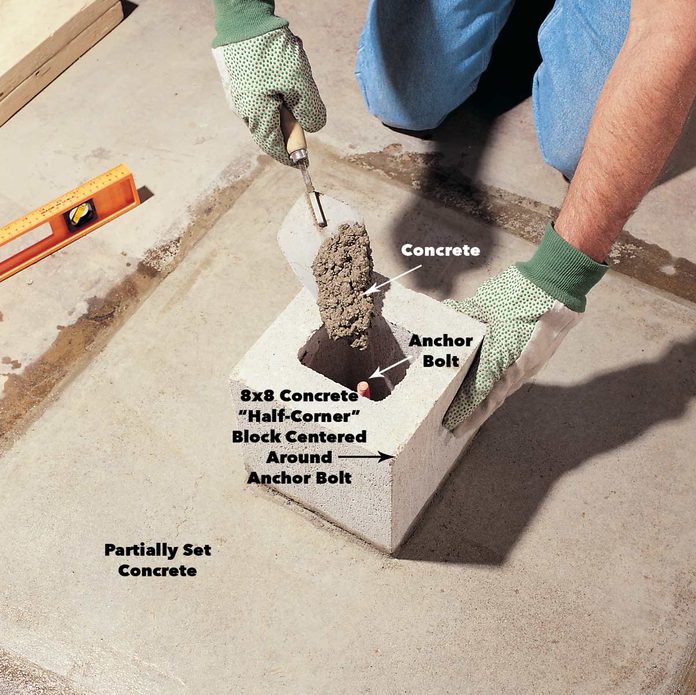
Level an 8x8 concrete block in freshly laid concrete, centering information technology around the anchor bolt. Completely fill up the core with physical. Salvage time past setting the plinth cake on a still-wet footing once the physical can support the weight of the cake. To conform our 6x8 forest mail service, we used a standard 8x8 one-half-corner block. Make sure your plinth is at to the lowest degree as big as your mail.
Footstep 12
Reinstalling the posts

Install the post on a new plinth and basis merely after the concrete has cured for seven days. Forest posts are easier to work with, so stick with wood rather than metal. Abode centers and lumberyards carry steel "mono-posts" and steel posts with telescoping sections, simply you need special skills and techniques to properly support wood beams with steel posts. Consult with engineers and/or local building officials before using them.
Your local building officials may insist you install only new, pressure level-treated 6x6 posts set on plinths. Nosotros had no such restrictions and reused our old wood posts because they were still tall enough after sawing off the rot. If this is the case for you too, measure the height betwixt the firm beam and the plinth, subtract iii/xvi in. and cut the old basement post to length. Saw a squared bottom from the rotted end, using a circular saw to girdle the post. End the cut with a handsaw.
Step xiii
Set the Post
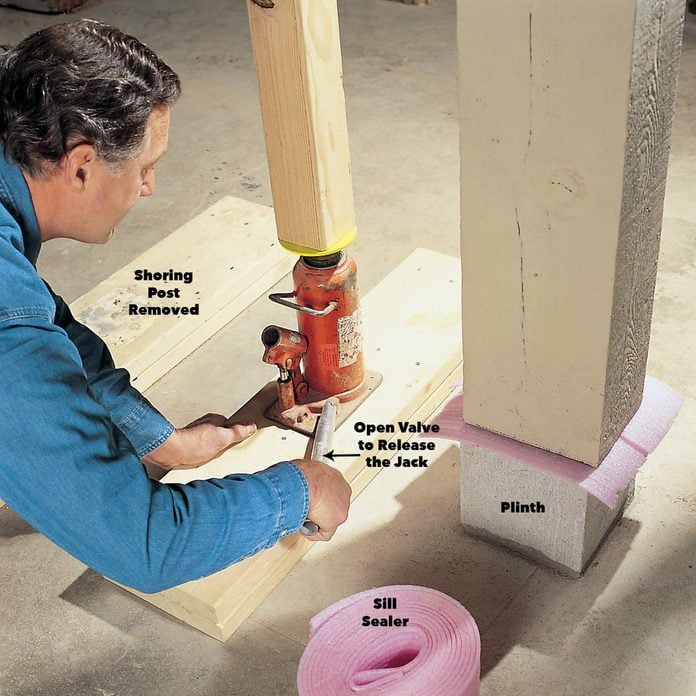
Almost old posts don't have a square, level top. Don't alter that. For the best contact and load transfer, reinstall the posts exactly in their original position under the house axle, with all those old irregularities fitting like a hand in glove. To forestall any moisture from wicking into the mail from the plinth, lay sill sealer or galvanized sheet metal between the two. Set up the mail on its plinth block, matching the mail acme to its prior contact position with the firm axle. Then reset the hydraulic jack, lower the shoring post, and very slowly open the valve of the hydraulic jack to carefully lower the beam onto the mail service.
In your excitement to reset the posts and cease the job, don't take risks. Utilize an assistant and lower the ceiling jack very slowly, leaving the shoring in identify while putting weight onto the posts.
Stride 14
Anchor the Mail service to the Plinth Block

Using a hammer drill fitted with a masonry scrap, predrill two 3/16-in. holes 1-ane/iv in. deep into opposite sides of the plinth cake. Install 1-ane/4 in. concrete screws through metal ballast straps into the plinth and then nail the straps to the wooden post with galvanized 10d box nails.
Footstep 15
Fasten the Axle and Postal service Together
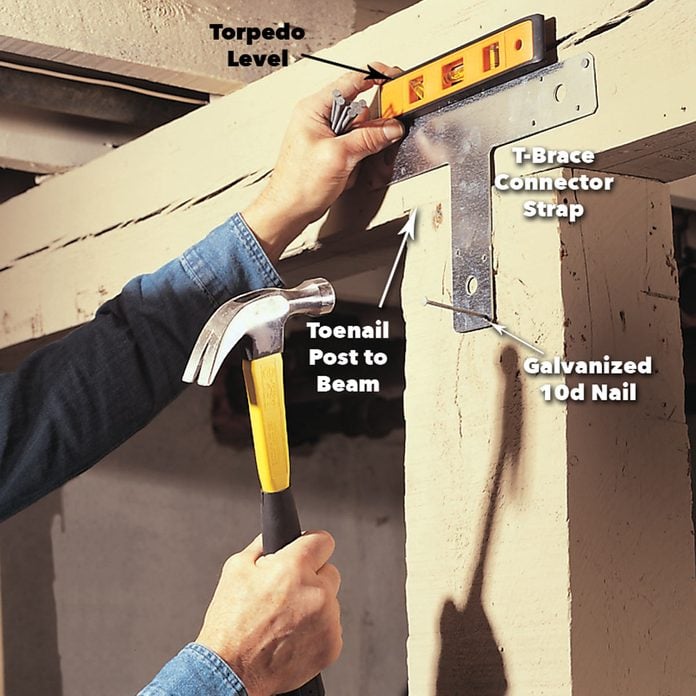
Bring together the support beam and wood load bearing mail by toenailing them together and attaching two metallic T-braces to contrary sides of the beam with galvanized 10d box nails. Once that'south washed and the back up strapping is reinstalled on all gas, electrical, plumbing and heating lines, you'll have the satisfaction of completing a job that will last for the life of the house.
Plus: Learn how to install a load-bearing beam hither.

Source: https://www.familyhandyman.com/project/how-to-repair-a-load-bearing-post/
Posted by: simpkinsmasul1949.blogspot.com
0 Response to "How To Repair Top Of A Post That's Rotting"
Post a Comment